
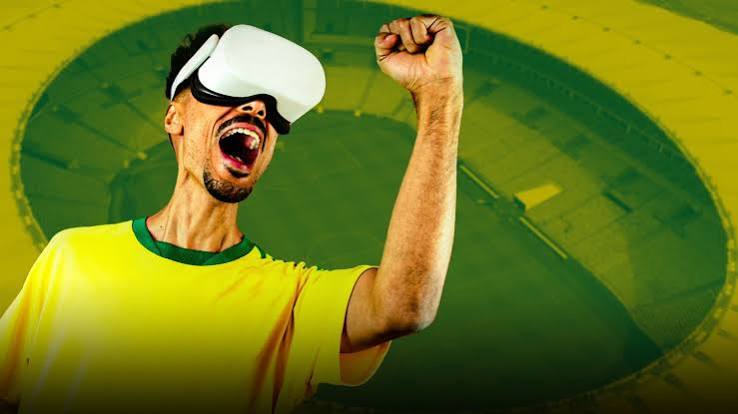
As VR and AR tools become more common in football broadcasting, they are starting to change what it means to “be there” for a World Cup match, even if you never leave your living room. Instead of accepting the single default TV angle, you can increasingly control where you sit virtually, which players you follow, and how much tactical or statistical information appears on your screen while the game unfolds in real time. That shift turns the home viewing experience into something much closer to a personalised tactical lab, where you can read pressing triggers, build-up structures, and chance quality as clearly as if you were studying the match from a coach’s camera.
What “Pitchside From the Sofa” Really Means
The promise of VR for World Cup viewing is not just about a 360-degree gimmick; it is about using tracking data and virtual stadiums to recreate the full field and the crowd so that you feel spatially present at the match while still at home. Systems that rebuild the game in a virtual environment based on real-time player and ball positions let you choose virtual seats—from behind the goal to high in the stands or even at field level—and switch angles instantly when you want to check spacing or movement. When you combine that freedom with spatial audio and subtle crowd details, the result is an experience where tactical shapes, pressing lines, and transition moments become easier to read than through a single broadcast camera, because you are not locked into someone else’s angle.
How VR Changes What You Notice in Live Matches
Watching a World Cup match in VR naturally shifts your focus from the ball to the space around it, because you can quickly look away from the immediate action and study team structure or off-ball runs. That freedom makes it easier to recognise how a back four squeezes up together, how a pivot midfielder screens passing lanes, or how a front line curves its press to force play into a trap, since you can position yourself at an angle that highlights those details rather than just following the TV director’s choices. Over time, you start to anticipate patterns—such as when a full-back is about to be isolated or when an overload is forming on one side—because VR lets you hold a wide view for longer, which is much closer to how coaches and analysts watch from elevated positions in the stadium.
Where AR Overlays Help With Tactical and Data Understanding
Augmented reality works differently from VR by layering information and graphics on top of the real broadcast, using tools like on-screen arrows, heatmaps, and real-time stat panels. In a World Cup match, AR can highlight pressing traps, show live passing networks, or surface metrics such as xG and progressive passes without forcing you to leave the main camera angle, so you stay connected to the flow while still getting analytical context. When these overlays are used sparingly and timed with replays or stoppages, they act like a visual coach: they confirm what you think you are seeing in terms of spacing and chance quality, and they help you link individual actions—like a through ball or a late midfield run—to the tactical structure that created them.
Mechanisms: From Tracking Data to Live Overlays
Under the surface, both VR and AR experiences rely on detailed tracking data that records every player’s position many times per second, along with the ball and sometimes even referees. Broadcasters and technology providers feed that data into visual engines that either reconstruct a 3D virtual stadium in real time for VR or dynamically draw lines, zones, and icons onto the 2D broadcast feed for AR. Because the data arrives with low latency, the overlays and virtual reconstructions can stay synchronised with the live action, meaning that when you see a high defensive line on your headset or a highlighted passing lane on screen, you are looking at a near-real-time representation of what is actually happening on the pitch rather than a delayed diagram.
Using VR and AR to Read Chance Quality and xG During World Cup Games
As broadcasters experiment with richer data integrations, VR and AR can help you understand chance quality in ways that go beyond a simple xG number on the scoreboard. In VR, being able to “stand” where a striker takes a shot—seeing the angle, the distance, the defenders’ positions, and the goalkeeper’s line—gives you an intuitive sense of why that attempt might be labelled as a high- or low-probability chance, even before you see any statistic. Meanwhile, AR overlays can show live shot maps, zones of frequent entries, or average shot locations, helping you recognise when a team’s attacks are consistently reaching dangerous central spaces or when they are being pushed into low-value wide or long-range efforts, which refines how you interpret whether a team is genuinely dominant or just firing from hopeful positions.
Why Live Viewing Still Matters More Than Replays in a VR/AR World
Even with sophisticated VR replays and AR highlight packages, the deepest insights into a World Cup match still tend to emerge when you watch the full ninety minutes live, because you can feel how tactical choices interact with momentum, fatigue, and game state in real time. When you follow an entire game, you see how a pressing scheme that looked sharp in the first 20 minutes begins to stretch under physical strain, or how a team gradually works out how to break a compact block, and VR or AR simply make those evolving patterns more visible by giving you better angles and clearer annotations. Replays, in contrast, inherently compress the narrative into key incidents, which can hide important sequences like repeated failed entries or long spells of territorial control that never make a highlights reel but define why the decisive chances appeared at all.
The Role of Live Streams and “ดูบอลสด” in Learning With VR and AR
For many fans, the entry point into this new ecosystem will still be straightforward live streams, but the key is how you use them to train your eye rather than just to passively consume goals and celebrations. When you watch ดูบอลสด through a platform that offers VR or AR enhancements, try shifting your attention away from pure entertainment and towards how those overlays or virtual angles confirm or challenge your own reading of the game, such as whether a press is actually forcing low-percentage shots or if a supposedly dominant team is struggling to create clean central chances. Over time, you can treat each stream as a kind of interactive classroom, using the tools to rewind sequences, switch perspectives, and compare live stats with your in-the-moment impressions, which gradually sharpens both your tactical intuition and your understanding of how different viewing technologies can either clarify or distort what is really happening on the pitch.
Table: How Different Viewing Setups Change What You Learn From a World Cup Match
To understand how technology affects your tactical reading of a World Cup game, it helps to compare different viewing setups side by side rather than assuming “more tech” is always better. The table below outlines what each common mode tends to reveal most clearly and where it can still leave gaps, so you can choose the right configuration depending on whether you want atmosphere, structure, or data-led insight from a particular match.
| Viewing mode | What you see best | What you might miss |
| Standard TV broadcast only | Atmosphere, close-ups, basic match flow and key incidents | Full team shapes off the ball, subtle pressing triggers, weak-side movements |
| TV with AR overlays | Passing options, live stats, highlighted pressing traps and shot maps | Some off-ball runs or structural shifts that occur outside the main camera frame |
| Full VR stadium recreation | Overall spacing, height of lines, rotations across the entire pitch | Fine details of individual technique or facial expressions that close TV shots show |
When you interpret this table, the point is not to crown a single “best” way to watch but to understand the trade-offs so you can tailor your setup to your analytical goals for each game. For instance, an early group match where you want to map a team’s overall structure may benefit from VR’s wide perspective, while a knockout match where you care about small tactical tweaks might be better suited to a TV feed with AR graphics that highlight specific passing lanes or pressing traps at key moments.
Practical Steps to Use VR and AR for Better Tactical Reading During the World Cup
If you are new to immersive tools, it can be hard to know where to start, and jumping between too many features can actually make it easier to miss important moments. A simple viewing routine helps you stay focused on the match itself while still using the technology to deepen your understanding of how teams build attacks, defend space, and manage transitions.
- At kick-off, pick a wide VR angle or zoomed-out TV view and spend at least 10 minutes focusing exclusively on team shape in and out of possession rather than switching cameras constantly.
- When a dangerous attack occurs, quickly revisit it using either an alternative VR perspective or an AR-enhanced replay to see where the move began and which players created the overload or space.
- During quieter spells, glance at AR overlays or stat panels to check whether your impression of which team is controlling chance quality matches indicators like shot maps or xG summaries.
- Around half-time, switch to a high, central view for a few minutes specifically to compare both teams’ pressing heights, distances between lines, and how often full-backs join midfield or stay deep.
- In the last 20 minutes, watch for how fatigue affects spacing and pressing, using VR or AR tools to track whether lines drop, gaps open, or new patterns emerge as substitutions change roles.
Following a structure like this means that the technology supports your analysis instead of distracting you, because each tool has a clear job at a specific stage of the match. Over several games, you will begin to see recurring solutions to common problems—such as how teams protect transitions or engineer cut-back chances—and VR and AR will feel less like novelties and more like essential lenses for interpreting what the World Cup is teaching you about modern ดูบอลสด changy.
Summary
VR and AR are reshaping what it means to watch the World Cup from home by giving you control over perspective, information density, and how closely you can track tactical structures in real time. By understanding what each technology reveals best—whether it is full-pitch spacing in VR or targeted data overlays in AR—you can design a viewing setup that turns every match into a live classroom for reading pressing patterns, chance quality, and momentum swings. When you approach immersive tools this way, “sitting by the pitch” becomes less about spectacle and more about building a sharper, more systematic understanding of how World Cup football actually works from the first minute to the last.