
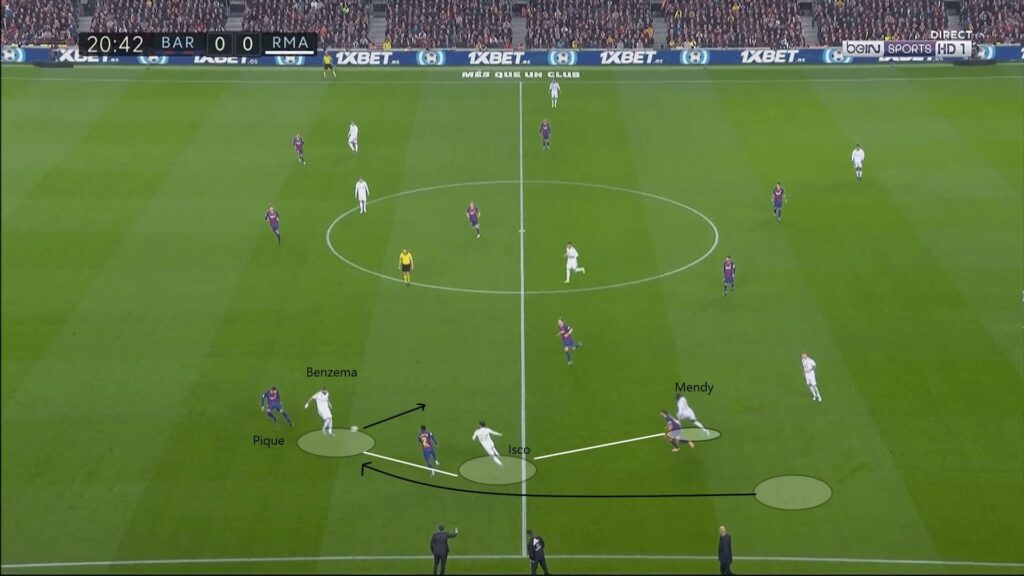
Wing-based build-up play has become a defining attacking route in Ligue 1, shaped by compact central defenses, athletic fullbacks, and transitional risk. Rather than serving purely as crossing platforms, wide areas function as progression corridors that help teams advance territory, manipulate defensive shape, and control match rhythm. Analyzing this approach requires understanding why teams choose the flanks, how those choices influence outcomes, and where reliance on wide build-up begins to fail.
Why wide-channel build-up is structurally attractive in Ligue 1
Central congestion is a recurring feature of Ligue 1 matches. Many teams defend narrowly to protect zone 14 and the half-spaces, forcing opponents to seek alternative progression routes. The cause is defensive compactness; the outcome is redirected circulation; the impact is increased reliance on wide channels to move the ball forward. Wide build-up offers safer passing lanes and reduces turnover risk in central areas, which is particularly important for teams facing strong counterattacking threats.
The role of fullbacks in initiating flank progression
Fullbacks are often the first accelerators of wide build-up. Instead of overlapping immediately, many Ligue 1 teams position fullbacks slightly deeper to receive under less pressure and draw opponents outward. Once engaged, they progress either through carries or quick combinations with wingers. This sequencing allows teams to advance without committing central midfielders too early, preserving rest defense and reducing vulnerability to central turnovers.
Wingers as connectors rather than pure dribblers
Modern wing play in Ligue 1 extends beyond isolated dribbling. Wingers frequently operate as connectors, recycling possession, drawing defenders, and releasing overlapping or underlapping runs. This role shift stabilizes wide build-up by reducing reliance on individual take-ons. Teams benefit from repeated two-versus-two scenarios near the touchline, which stretch defensive units laterally and open delayed central access.
Teams that consistently emphasize flank-based progression
Several Ligue 1 teams integrate wide build-up as a core identity. Paris Saint-Germain use flank progression to isolate defenders before switching play, while Stade Rennais rely on structured wing rotations to advance into the final third. AS Monaco frequently use early wide progression to accelerate transitions and exploit backpedaling defenses. Despite stylistic differences, all three treat wide zones as engines of territorial gain.
Common patterns that emerge from wide build-up play
Before assessing effectiveness, it is useful to identify the repeatable patterns that wide build-up creates. These patterns explain why flank progression can feel dominant without immediately producing goals.
Wide build-up sequences often include:
- Early switches to isolate a winger against a single defender
- Overlapping runs to force fullback decisions
- Delayed cut-backs after reaching the byline
- Recycled possession back to midfield to reset pressure
Interpreting these patterns shows that wide build-up prioritizes control over immediacy. Teams use the flanks to manipulate defensive shape first, then search for central access second. When successful, this approach increases sustained pressure and territorial dominance even if shot volume rises slowly.
Effectiveness indicators and structural trade-offs
Wide build-up tends to improve entry frequency into the final third but can reduce central shot quality if overused. Teams that rely heavily on flanks often face packed penalty areas and rely on second balls or cut-backs rather than clear shooting lanes. The trade-off is clear: safety and control versus unpredictability. In Ligue 1, where defensive blocks are well-drilled, teams must balance width with timely central movement to avoid sterile dominance.
To clarify this balance, the table below outlines key benefits and limitations of wide build-up structures.
| Aspect | Advantage | Limitation |
| Flank progression | Safer ball advancement | Predictable attack angles |
| Touchline overloads | Stretch defensive width | Reduced central space |
| Crossing zones | Increased chance volume | Lower average shot quality |
Reading the table highlights that wide build-up redistributes risk rather than eliminating it. Teams that combine flank play with late central runs tend to extract the most value from this structure.
Educational interpretation during analytical review
From an educational perspective, wide build-up illustrates how teams manage spatial risk. Analysts studying matches often focus on whether flank progression leads to repeated structural advantages or simply recycles possession. During broader analytical review across a betting interface, references to ยูฟ่าเบท168 vip may appear when observers compare how wing-dominant teams influence tempo, corner frequency, or shot distribution. The key learning point is recognizing when wide build-up signals sustainable pressure versus harmless circulation.
Where wide-channel build-up tends to break down
Reliance on flank play weakens when opponents defend aggressively near the touchline or win aerial duels consistently. Without central support, teams can become trapped in repetitive crossing patterns that favor defenders. Ligue 1 sides with limited aerial presence often struggle once opponents anticipate wide delivery routes, forcing rushed decisions and turnovers far from goal.
Conditional scenarios that reduce effectiveness
Wide build-up loses efficiency when referees allow physical contact on the flanks or when pitch conditions slow ball circulation, reducing the precision these patterns depend on.
Summary
Wide-channel build-up play in Ligue 1 is a structurally sound response to central congestion and transitional risk. By using flanks as progression corridors, teams gain control, stretch defenses, and sustain pressure. However, effectiveness depends on balance: without coordinated central movement and variation, wide dominance becomes predictable. Understanding these dynamics clarifies why flank-based attacks are prevalent and how they succeed or fail within the league’s tactical environment.