
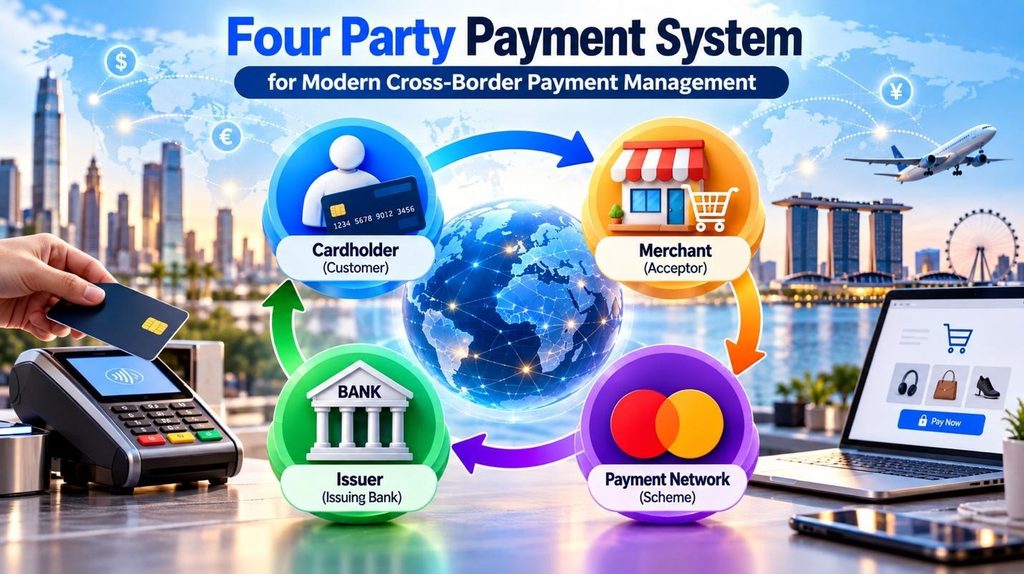
Digital commerce is increasingly international, but payment management often remains fragmented. A business may need to work with different payment providers, merchants, agents, settlement structures, and regional transaction methods at the same time. A Four party payment system creates a more organized framework for connecting these elements and managing them through a centralized payment environment.
Instead of operating several disconnected payment systems, businesses can use one infrastructure to coordinate payment collection, payouts, transaction routing, merchant activity, reconciliation, monitoring, and financial administration.
A More Organized Payment Architecture
A 四方支付系统 is useful when a company needs to combine multiple payment channels without creating a completely separate management process for every integration.
As transaction networks grow, administrators may need to monitor different channels, review payment orders, configure merchant accounts, change processing rules, and manage settlement information. Centralizing these functions makes the overall payment operation easier to understand and maintain.
This structure can also reduce duplicated administrative work when businesses expand into new regions.
Connecting Regional Payment Channels
Different countries often have different payment habits and local transaction methods. A business entering multiple markets therefore needs payment infrastructure that can adapt to regional requirements.
A Four party payment system can connect multiple channels within one broader architecture. New providers can be introduced while existing merchant and administrative functions remain within the same operating environment.
This approach is especially suitable for businesses working across markets in Asia, Africa, Latin America, North America, and other international regions.
Rather than rebuilding the complete system for every new country, companies can extend their existing payment infrastructure.
Dynamic Transaction Routing
Payment routing determines which available channel handles a particular transaction.
With a Four party payment system, operators can create routing configurations based on factors such as transaction amount, channel priority, availability, processing limits, and operating conditions.
For example, when several channels are active, payment traffic can be distributed between them rather than depending entirely on one provider.
If the condition of a channel changes, administrators can modify routing settings to maintain a more balanced transaction flow.
Merchant Configuration and Account Control
Merchant networks can become difficult to manage when different businesses require different commercial arrangements.
A Four party payment system allows operators to create merchant-specific configurations. Payment access, transaction restrictions, rates, available channels, and settlement settings can be organized according to individual account requirements.
This provides businesses with greater control as the number of merchants increases.
Centralized merchant administration also gives operational teams a clearer view of transaction activity across the wider network.
Agent and Commission Management
Businesses operating through agents or partner networks may need additional account structures.
A Four party payment system can support different agent levels and commercial arrangements while keeping them connected to the main payment environment.
Administrators can organize rates, commissions, merchant relationships, and payment activity according to the business model being used.
This provides a more structured way to manage complex relationships without relying heavily on external spreadsheets or disconnected administrative processes.
Payment Collection and Payout Operations
A complete payment environment often needs to manage both incoming and outgoing transactions.
The Four party payment system can support payment collection alongside payout management, giving businesses better visibility into the entire transaction lifecycle.
Operators can review payment orders, payout records, transaction amounts, processing status, and related merchant information.
Keeping these records within one system helps create greater operational consistency.
Clearer Settlement and Reconciliation
Accurate settlement is essential when many payment channels and merchants are involved.
A Four party payment system can organize transaction records together with merchant rates, channel costs, balances, and settlement calculations.
This creates a clearer financial overview and makes reconciliation easier to manage.
Administrators can compare payment activity against system records, investigate inconsistencies, and maintain a more organized history of transactions.
Monitoring Transaction Performance
Payment channels can perform differently depending on traffic volume, regional conditions, technical availability, or provider restrictions.
A Four party payment system can give operators access to transaction statistics and channel-performance information.
Teams can monitor successful payments, failed transactions, pending orders, payout activity, and other operational indicators.
This information can help businesses understand how different payment channels are performing and determine when configuration changes may be necessary.
Security and Transaction Control
Payment infrastructure requires strong protection at several levels.
A Four party payment system can incorporate measures such as encrypted transaction communication, signature verification, callback validation, IP controls, transaction limits, and unusual-order monitoring.
These controls add additional protection around payment processing and administrative activity.
Businesses should also maintain appropriate compliance, financial-control, data-protection, and regulatory procedures according to the jurisdictions where their services operate.
Flexible Deployment for Growing Businesses
Different businesses may have different technical requirements. Some organizations prefer greater control over their payment environment, system configuration, and future development.
A Four party payment system can support source-code deployment and customized infrastructure configuration. Payment interfaces, administrative functions, databases, merchant modules, reporting features, and transaction-management tools can be deployed according to operational needs.
This flexibility can be useful for businesses that expect their payment infrastructure to evolve over time.
Creating a Scalable Payment Network
Growth introduces additional complexity. More merchants can mean more transactions, while expansion into new countries can require additional payment channels and different settlement configurations.
A Four party payment system provides a scalable structure where these additions can be managed without replacing the entire payment environment.
Businesses can continue adding channels, merchants, agents, and regional payment options while maintaining centralized administration.
Conclusion
A 四方支付系统 provides a practical framework for businesses that need to manage increasingly complex payment operations. By connecting multiple payment channels with routing, merchant management, agent configuration, settlement, reconciliation, transaction monitoring, security controls, and flexible deployment, it creates a more unified payment environment.
For companies expanding internationally or managing several payment providers, a well-structured Four party payment system can help simplify operations while providing greater visibility and control over the complete transaction network.