
Checking a kèo nhà cái takes 10 seconds. Understanding what it means takes considerably longer — and that gap is where most bettors either build an edge or lose one.
Deep analysis is not about complexity for its own sake. It is about asking the right questions before a match: Is this handicap line consistent with what the underlying data suggests? Has the total moved in a direction that signals something about expected tempo? Which operator is pricing this fixture differently from the rest, and why? These are not exotic questions — they are the standard ones that serious bettors ask every time. Kèo Nhà Cái at keonhacai95.com gives those questions somewhere productive to start.
What Deep Analysis Means in Practice
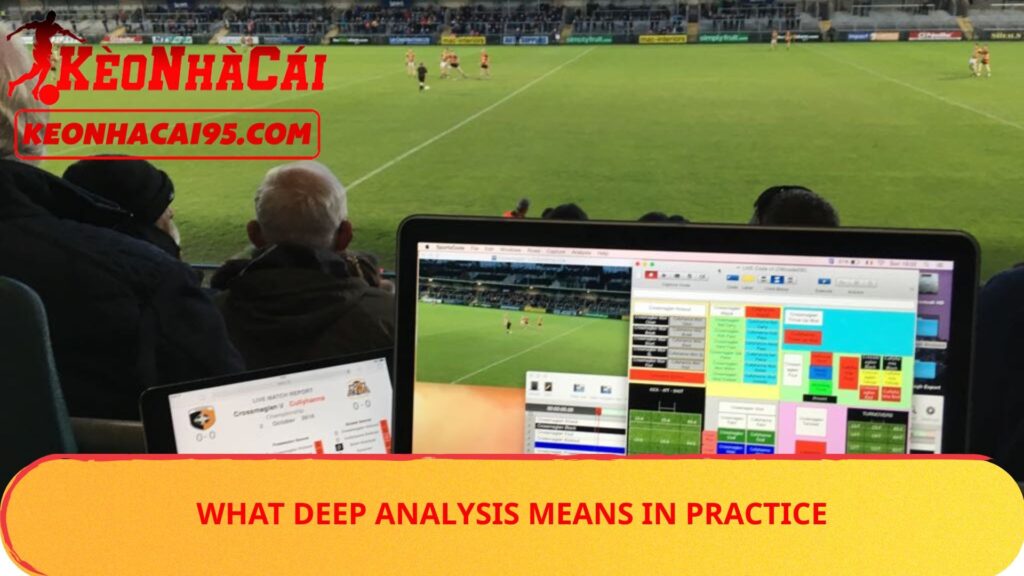
The phrase “deep analysis” gets used loosely. For football betting specifically, it has a fairly concrete meaning: going beyond surface results to understand the factors that shaped those results, then applying that understanding to how the current fixture is priced.
Starting with the Odds, Not the Teams
Counterintuitively, deep analysis often begins with the kèo nhà cái line rather than the teams. The line is a compressed summary of everything the market currently believes about a fixture — form, squad health, tactical matchup, and historical record all folded into a single number.
Starting there means you immediately know what you would need to disagree with to find value. If the market has Team A at -1, your analysis either supports that assessment or argues against it. This is a sharper starting point than forming a view independently and then checking whether the odds are attractive.
Breaking Down the Handicap
A handicap line answers 1 question: how much does the market think the stronger side will win by? But embedded in that answer are several assumptions worth unpacking:
- Is the favourite’s recent form a reliable indicator, or is it inflated by weak opposition?
- Is the underdog’s defensive record solid enough to cover a -1 line, even in a loss?
- Does the head-to-head history between these 2 sides suggest the favourite consistently underperforms the handicap?
None of these questions has an automatic answer. Each one requires looking at specific data — not just a summary stat.
Reading the Total Alongside the Handicap
The Over/Under line is the market’s view on match tempo and combined scoring. When read alongside the handicap, it fills in detail that the handicap alone cannot provide.
A -1.5 handicap with a 2.5 total suggests the market expects a tight, low-scoring match where 1 side edges it narrowly. A -1.5 handicap with a 3.5 total suggests a more open game where the stronger side wins by a bigger margin. These are different matches to analyse — and different bets to consider.
The Data Points That Actually Move Odds

Understanding which inputs drive kèo nhà cái movement helps bettors interpret what they see on screen. Not all movement is equal.
Confirmed Lineup and Injury News
This is the single most significant driver of short-term odds movement. A confirmed absence of a starting goalkeeper, a key centre-back, or the team’s primary striker can shift a handicap line by 0.25 to 0.5 within minutes of the announcement. Bettors who monitor squad news in the 24 to 48 hours before kickoff have an informational advantage over those who check only on match day.
Sharp Money vs. Public Volume
Markets respond differently to different types of money. High-volume casual betting on a popular team may push a line in 1 direction — but sharp operators with large stakes and strong track records tend to pull it back if they disagree. When a line moves against the direction of public sentiment, that reversal is worth investigating.
Competition Stage and Match Stakes
A team that has already secured their league title or European qualification plays differently in their final regular-season fixture. Bookmakers price this in. A kèo nhà cái that looks generous for a heavy favourite may simply reflect the market’s awareness that motivation is limited.
(Betting odds data collected from: https://keonhacai95.com/)
How Keonhacai95.com Supports This Level of Analysis
A platform built for deep analysis needs to offer more than a current line. It needs to give bettors the tools to work through the questions above without having to cross-reference 6 separate sources.
Odds Movement Timeline
The platform logs how kèo nhà cái lines have shifted since opening, giving bettors a visual record of market behaviour across the days before each fixture. This timeline is the raw material for identifying sharp movement, tracking the impact of news events, and comparing early lines against closing figures.
Side-by-Side Bookmaker View
Keonhacai95.com surfaces lines from multiple operators simultaneously. For deep analysis, this means you can immediately see if 1 bookmaker is an outlier — pricing a match significantly differently from the consensus. Outliers are either opportunities or warnings, and identifying them quickly matters.
Match Context Data
Alongside the odds themselves, the platform integrates supporting match data — recent results, head-to-head records, and relevant contextual information — so bettors can cross-reference their analytical questions without leaving the platform.
Building a Deep Analysis Habit Without Overcomplicating It
Deep analysis does not require a spreadsheet model or a background in statistics. It requires consistency — asking the same questions before every bet, in the same order, so that nothing important gets skipped.
A simple structure that works for most bettors:
First: Check the opening kèo nhà cái line and note the handicap and total. This is your market baseline.
Second: Review the last 5 to 6 results for each side, with context — opponent quality, home or away, and margin of result.
Third: Check squad news. If anything significant has changed in the last 48 hours, reassess.
Fourth: Compare the current line against the opening. If it has moved significantly, identify what caused it.
Fifth: Decide whether your analysis supports, contradicts, or is neutral on the market’s view. Only the first 2 cases are actionable.
This process takes 15 to 20 minutes per fixture. Done consistently across 30 to 40 bets, it builds a detailed picture of where your analysis is reliable and where it tends to drift.
Conclusion
Deep kèo nhà cái analysis is a discipline, not a technique. It is built from consistent habits — starting with the line, asking the right questions about what drives it, and comparing your conclusions against the market’s view before committing.
Keonhacai95.com supports this process by providing the data infrastructure that deep analysis requires: odds timelines, multi-bookmaker comparisons, and match context in one place. For bettors ready to engage with football wagering at a more serious level, this is a practical and reliable starting point.